PE-PROC-01الإصدار 1.1 · آخر مراجعة أكتوبر 2026 · المراجعة القادمة أكتوبر 2028Version 1.1 · Last reviewed October 2026 · Next review October 2028
يُرجى قراءة هذه النشرة بعناية قبل موعدك وإحضارها معك يوم الفحص. وإذا كان أي أمر غير واضح، تواصل مع وحدة المناظير قبل الموعد لا في يوم الفحص.
ما هو تنظير القولون؟
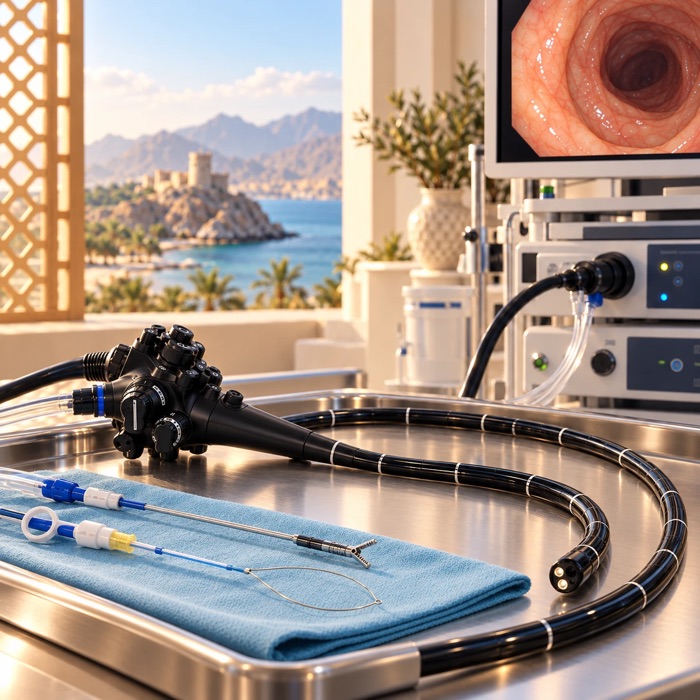
تنظير القولون فحص للأمعاء الغليظة باستخدام أنبوب رفيع مرن مزوّد بكاميرا في طرفه، يُدخل بلطف عبر فتحة الشرج. ويستغرق الفحص عادة من ٢٠ إلى ٤٥ دقيقة. وإذا وُجدت زائدة لحمية (سليلة) أمكن استئصالها في الجلسة نفسها، كما يمكن أخذ عينات نسيجية صغيرة، وأخذ العينات غير مؤلم.
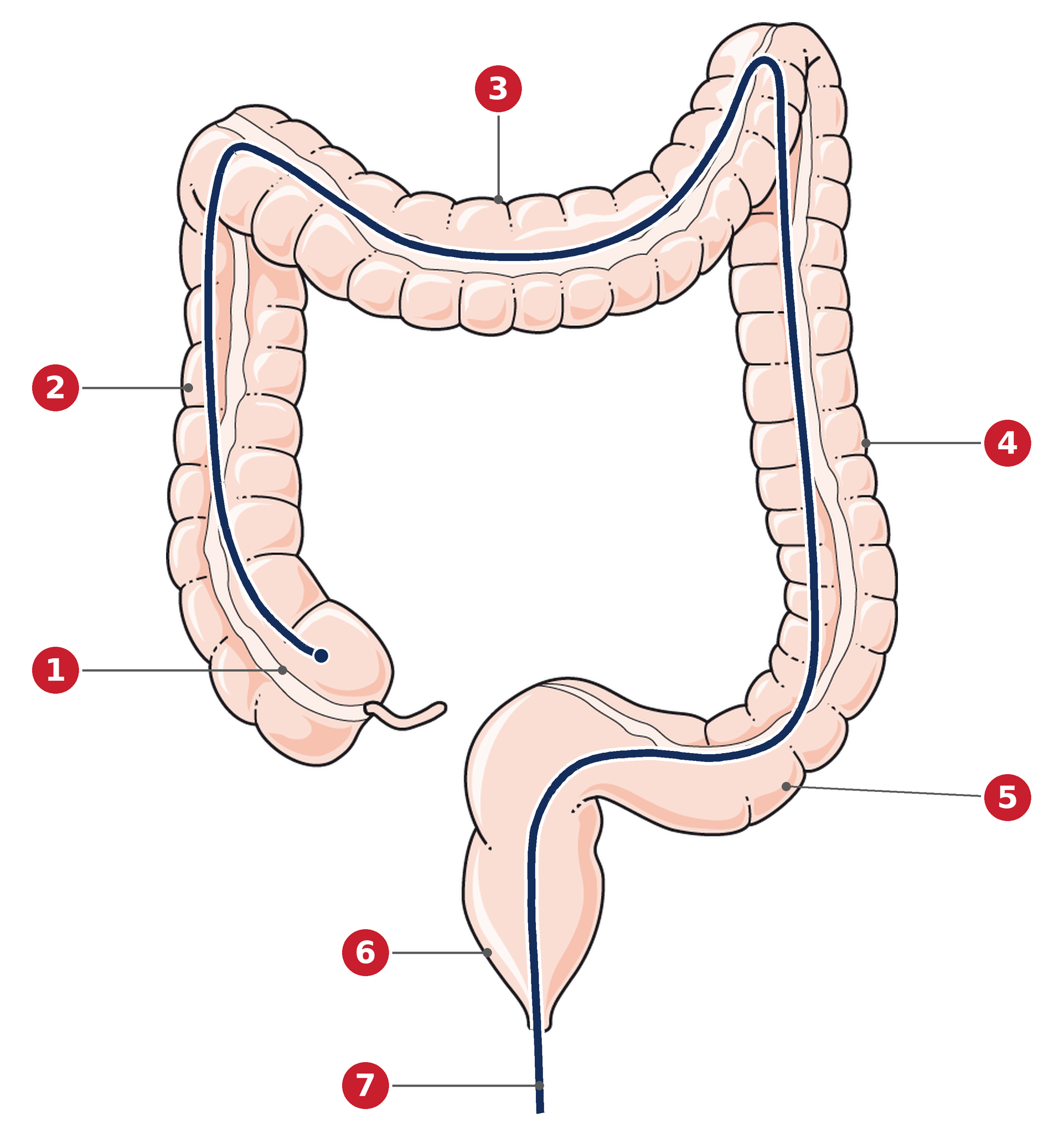
1 الأعور، بداية القولون (يهدف الفحص إلى الوصول إليه)
الرسم التوضيحي مقتبس من Servier Medical Art (smart.servier.com) بترخيص CC BY 4.0.
لماذا يُنصح بهذا الفحص؟
من الأسباب الشائعة: نزول دم من فتحة الشرج، تغيّر في عادة التبرز، فقر دم أو نقص وزن غير مُفسَّر، إسهال مستمر أو ألم بطني متكرر، الفحص المبكر للوقاية من سرطان القولون، تقييم أمراض الأمعاء الالتهابية، ومتابعة السلائل التي سبق استئصالها أو سرطان سبق علاجه.
ما فوائده؟
تنظير القولون هو أدق فحص متاح لبطانة الأمعاء الغليظة، وهو الفحص الوحيد الذي يشخّص ويعالج في الوقت نفسه. واستئصال السلائل قبل أن تتحول إلى سرطان يقلّل خطر الإصابة بسرطان القولون، كما أن السرطان المكتشف في مرحلة مبكرة يمكن علاجه بنجاح في معظم الحالات. والنتيجة الطبيعية تبعث على الطمأنينة وتغني غالباً عن فحوصات أخرى.
التحضير للفحص: تنظيف الأمعاء
تنظيف الأمعاء هو أهم جزء في التحضير؛ فالبقايا داخل القولون تحجب الرؤية، وقد تؤدي إلى تفويت السلائل أو إلى إعادة الفحص.
قبل ثلاثة أيام: توقف عن الأطعمة الغنية بالألياف، مثل الخبز والحبوب الكاملة، والأرز الأسمر، والمكسرات، والبذور، والفواكه المجففة، والخضار والفواكه النيئة، والبقوليات والعدس.
في اليوم السابق: يُفضَّل ألا تتناول أي طعام صلب طوال اليوم. وإذا احتجت إلى الأكل فليكن فطورًا وغداءً خفيفين قليلي الألياف، ولا تتناول أي طعام صلب بعد الغداء، واكتفِ بالسوائل الصافية بما لا يقل عن لترين.
محلول تنظيف الأمعاء الذي يعطيك إياه فريق المناظير: تناول الجرعة الأولى مساء اليوم السابق، والجرعة الثانية قبل موعدك بأربع إلى ست ساعات، على أن تنتهي منها قبل ساعتين على الأقل من الفحص. وتقسيم الجرعة بهذه الطريقة ينظّف القولون أفضل بكثير من تناولها كاملة في الليلة السابقة. ومع ذلك، فالتعليمات النهائية هي التي يعطيك إياها فريق المناظير الذي شرح لك طريقة تنظيف الأمعاء. ولا ينطبق هذا التوقيت إذا كان سيُجرى لك تنظير للمعدة مع تنظير القولون في الموعد نفسه، فاتبع حينها التوقيت الذي يحدده لك فريق المناظير.
السوائل الصافية المسموحة: الماء، والشاي أو القهوة بدون حليب، والمرق الصافي، وعصير التفاح المصفّى، والمشروبات الغازية الصافية. وتجنّب أي سائل أحمر أو بنفسجي اللون، وتجنّب الحليب والعصائر التي تحتوي على لُب.
يوم الفحص: توقف عن جميع السوائل قبل ساعتين من موعدك.
ابقَ قريباً من دورة المياه بعد بدء المحلول؛ فتكرار التبرز اللين أمر متوقع، ويساعد استعمال كريم واقٍ على حماية الجلد.
الأدوية
مميّعات الدم — الوارفارين، الأسبرين، كلوبيدوغريل، تيكاغريلور، براسوغريل، ريفاروكسابان، أبيكسابان، دابيغاتران، إيدوكسابان: تواصل مع الوحدة قبل الموعد بسبعة أيام على الأقل. ولا توقف هذه الأدوية من تلقاء نفسك، فإيقافها دون استشارة قد يكون خطراً.
أقراص الحديد: أوقفها قبل الفحص بخمسة إلى سبعة أيام.
الأدوية المسبّبة للإمساك ومضادات الإسهال (لوبيراميد، كودايين) ومكمّلات الألياف: أوقفها قبل ثلاثة أيام.
السكري: أبلغ الوحدة مسبقاً، وستُعطى تعليمات مكتوبة منفصلة بشأن الإنسولين أو الأقراص.
إبر إنقاص الوزن أو السكري (سيماغلوتايد، ليراغلوتايد، دولاغلوتايد، تيرزيباتايد): أخبر الوحدة، فقد تلزم تعليمات إضافية لتقليل المخاطر أثناء التخدير.
بقية أدويتك المنتظمة: تناولها كالمعتاد مع رشفة ماء، بما في ذلك صباح يوم الفحص.
التخدير والمرافق
يُعطى معظم المرضى مهدئاً ومسكّناً عبر الوريد، فتشعر بالنعاس والراحة ولا تتذكر غالباً تفاصيل الفحص. ويمكنك أيضاً اختيار إجراء الفحص دون تخدير.
وإذا تلقيت مهدئاً فيجب أن يرافقك شخص بالغ مسؤول إلى المنزل، وأن يبقى معك بقية اليوم. وخلال أربع وعشرين ساعة بعد التخدير: لا تقد السيارة، ولا تستخدم المواصلات العامة بمفردك، ولا تشغّل الآلات ولا تطبخ، ولا توقّع أوراقاً رسمية، ولا تتناول الكحول، ولا ترعَ أطفالاً صغاراً بمفردك. وقد يُؤجَّل الفحص إذا لم يتوفر مرافق.
يوم الفحص
احضر في الوقت المحدد في بطاقة الموعد، ومعك البطاقة وإثبات الهوية وقائمة أدويتك. سيراجع فريق التمريض بياناتك، ويستكمل الطبيب معك نموذج الموافقة. ثم تُبدّل ملابسك برداء المستشفى، وتُركّب كانيولا في الذراع، وتُراقَب النبض وضغط الدم ونسبة الأكسجين. وستستلقي على جانبك الأيسر. ويُستخدم الهواء أو ثاني أكسيد الكربون لتوسيع الأمعاء، لذا فالانتفاخ وخروج الغازات بعد الفحص أمر طبيعي ومتوقع. وأخبر الفريق في أي وقت إذا شعرت بألم، فبالإمكان إيقاف الفحص مؤقتاً أو إنهاؤه.
ما هي المخاطر؟
تنظير القولون إجراء آمن، والمضاعفات الخطيرة تحدث لدى نحو شخص إلى أربعة أشخاص من كل ألف.
المضاعفة
مدى تكرارها
انثقاب جدار الأمعاء
نحو ١ من كل ١٠٠٠ إلى ٣٠٠٠ في الفحص الروتيني، وترتفع إلى نحو ١ من كل ١٠٠ عند استئصال سليلة كبيرة. وقد يستدعي الأمر إجراء عملية جراحية.
نزيف، غالباً بعد استئصال سليلة أو أخذ عينة
نحو ١ من كل ١٥٠ فحصاً تُستأصل فيه سليلة، ونحو ٤ من كل ١٠٠ بعد استئصال سليلة كبيرة. ويتوقف عادة من تلقاء نفسه، ويحتاج نحو ١ من كل ٢٥٠٠ إلى نقل دم.
تأثير المهدئ على التنفس أو النبض أو ضغط الدم
آثار قصيرة الأمد مثل انخفاض نسبة الأكسجين أو ضغط الدم لدى نحو ١ من كل ١٠٠. أما الطوارئ القلبية أو التنفسية الخطيرة فأندر بكثير. وتتم مراقبتك طوال الفحص وهذه الآثار قابلة للعلاج.
عدم اكتمال الفحص وتعذّر رؤية القولون بالكامل
نحو ٥ إلى ١٠ من كل ١٠٠. وقد يتطلب ذلك إعادة الفحص أو إجراء تصوير مقطعي للقولون.
عدم رؤية سليلة أو ورم أثناء الفحص
الفحص دقيق لكنه ليس مثالياً، فقد تفوت السلائل الصغيرة أو المسطحة. ولهذا تُعدّ جودة تنظيف الأمعاء والالتزام بمواعيد المتابعة أمراً مهماً.
الوفاة المرتبطة مباشرة بالإجراء
نادرة جداً، نحو ٣ من كل ١٠٠ ألف.
هل توجد بدائل؟
تصوير القولون بالأشعة المقطعية يحتاج أيضاً إلى تنظيف الأمعاء، ولا يسمح بأخذ عينات أو استئصال السلائل، وأي خلل يُكتشف فيه يستدعي غالباً إجراء تنظير بعده. أما تنظير القولون السيني المرن فيفحص الجزء الأيسر من القولون فقط. وفحوصات البراز قد تشير إلى وجود مشكلة لكنها لا تستبعدها. ولا يبلغ أي من هذه البدائل دقة تنظير القولون. كما أن عدم إجراء الفحص خيار مطروح، وينبغي أن تناقش مع طبيبك ما قد يفوتك حينها.
بعد الفحص
تستريح في غرفة الإفاقة من ٣٠ إلى ٦٠ دقيقة، ثم يمكنك الأكل والشرب كالمعتاد ما لم يُنصح بغير ذلك. والانتفاخ والمغص الخفيف لبضع ساعات أمر طبيعي ويخف بالمشي، كما أن نزول قليل من الدم مع أول تبرز شائع بعد أخذ العينات أو استئصال السلائل.
وتُشرح لك النتائج قبل مغادرتك ويُسلَّم إليك تقرير مكتوب. وبما أن المهدئ يؤثر على الذاكرة، اطلب إعادة الشرح أو إعطاءه للشخص المرافق. وتستغرق نتائج العينات عادة من أسبوعين إلى أربعة أسابيع وتُناقش في العيادة. وإذا استُؤصلت سليلة فالتزم بموعد التنظير التالي المحدد لك، فإعادة الفحص في وقته جزء أساسي من الوقاية من سرطان القولون.
متى تطلب المساعدة العاجلة
توجّه إلى أقرب قسم للطوارئ إذا ظهر عليك خلال أسبوعين من الفحص أي مما يلي:
ألم بطني شديد أو متزايد، أو انتفاخ وتصلّب في البطن
ارتفاع في درجة الحرارة أو قشعريرة
نزيف غزير أو متكرر من فتحة الشرج، أو نزول تجلطات كبيرة
دوخة أو إغماء أو براز أسود
ألم في الصدر أو صعوبة في التنفس
خذ هذه النشرة معك وأخبر الفريق الطبي بأنك خضعت لتنظير القولون.
للتواصل
للمواعيد والاستفسارات، تواصل مع وحدة المناظير عبر الأرقام التي زوّدتك بها. وإذا كانت حالتك شديدة أو كان الوقت خارج أوقات العمل فتوجّه إلى قسم الطوارئ بدلاً من انتظار الرد.
أُعدّت استناداً إلى معلومات البرنامج الوطني البريطاني للكشف عن سرطان القولون، ومعايير الجودة الأمريكية والأوروبية والبريطانية لتنظير القولون. وهي تدعم مناقشتك مع طبيبك وإجراءات الموافقة ولا تحل محلها. PE-PROC-01 · الإصدار ١٫١ · أكتوبر ٢٠٢٦ · المراجعة: أكتوبر ٢٠٢٨
هذه النشرة معلومات عامة ولا تغني عن مشورة طبيبك المعالج.
زاد صحي، PE-PROC-01
Please read this sheet carefully before your appointment and bring it with you on the day. If anything is unclear, contact the Endoscopy Unit before your procedure rather than on the day.
What is a colonoscopy?
A colonoscopy is an examination of the large bowel (colon) using a thin, flexible tube with a camera at its tip. The tube is passed gently through the back passage. The examination usually takes 20 to 45 minutes. If a growth (polyp) is found it can usually be removed during the same examination, and small tissue samples (biopsies) can be taken. Taking biopsies is not painful.
1 Caecum, where the colon begins (the test aims to reach here)
2 Ascending colon
3 Transverse colon
4 Descending colon
5 Sigmoid colon
6 Rectum and back passage (anus)
7 Colonoscope, the thin flexible tube with a camera
Illustration adapted from Servier Medical Art (smart.servier.com), licensed under CC BY 4.0.
Why has it been recommended for me?
Common reasons include bleeding from the back passage, a change in bowel habit, unexplained anaemia or weight loss, persistent diarrhoea or abdominal pain, bowel cancer screening and prevention, assessment of inflammatory bowel disease, and follow-up after polyp removal or a previous cancer.
What are the benefits?
Colonoscopy is the most accurate test for the lining of the large bowel, and the only one that both diagnoses and treats. Removing polyps before they become cancerous lowers your risk of bowel cancer, and a cancer found early can usually be treated successfully. A normal result is reassuring and often avoids further tests.
Preparing for the test: bowel cleansing
Bowel cleansing is the most important part of your preparation. Residue left in the colon hides the bowel lining, so polyps can be missed and the test may have to be repeated.
Three days before: stop high-fibre foods — wholegrain bread and cereals, brown rice, nuts, seeds, dried fruit, raw fruit and vegetables, pulses and lentils.
The day before: ideally no solid food all day. If you need to eat, have only a light low-fibre (low-residue) breakfast and lunch, and no solid food after lunch. Take clear fluids only, and aim for at least 2 litres.
The bowel preparation solution given to you by the endoscopy staff: first dose on the evening before, second dose 4 to 6 hours before your appointment, finishing at least 2 hours before. Splitting the dose this way gives a much cleaner bowel than taking it all the night before. However, the final instructions are the ones given to you by the endoscopy staff who explained your bowel preparation. This timing does not apply if you are having a gastroscopy (OGD) together with your colonoscopy; follow the timing the endoscopy staff give you.
Clear fluids allowed: water, clear tea or coffee without milk, clear soup or broth, strained apple juice, clear fizzy drinks. Avoid anything red or purple, and avoid milk or juices containing pulp.
On the day: stop all fluids 2 hours before your appointment time.
Stay close to a toilet once you start the preparation; frequent loose motions are expected. A barrier cream helps protect the skin.
Your medicines
Blood thinners — warfarin, aspirin, clopidogrel, ticagrelor, prasugrel, rivaroxaban, apixaban, dabigatran, edoxaban: contact the unit at least 7 days before. Do not stop these on your own; stopping without advice can be dangerous.
Iron tablets: stop 5 to 7 days before the test.
Constipating medicines and anti-diarrhoeals (loperamide, codeine) and fibre supplements: stop 3 days before.
Diabetes: tell the unit in advance. You will be given separate written instructions for your insulin or tablets.
Weight-loss or diabetes injections (semaglutide, liraglutide, dulaglutide, tirzepatide): tell the unit, as extra instructions may be needed to reduce risk during sedation.
All your other regular medicines: take them as usual with a sip of water, including on the morning of the procedure.
Sedation and your escort
Most patients are given a sedative and a painkiller through a vein. You will be drowsy and comfortable and will usually remember little of the test. You may also choose to have the examination without sedation.
If you have sedation you must be taken home by a responsible adult, and someone should stay with you for the rest of the day. For 24 hours afterwards do not drive, do not travel alone on public transport, do not operate machinery or cook, do not sign legal documents, do not drink alcohol, and do not care for young children on your own. Your procedure may be postponed if no escort is available.
On the day
Arrive at the time on your appointment card with your identification and a list of your medicines. The nursing team will check your details and complete the consent form with the doctor. You will change into a gown, a cannula will be placed in your arm, and your pulse, blood pressure and oxygen level monitored while you lie on your left side. Air or carbon dioxide is used to open up the bowel, so bloating and passing wind afterwards is normal. Tell the team at any point if you are uncomfortable — the test can be paused or stopped.
What are the risks?
Colonoscopy is a safe procedure. Serious complications affect about 1 to 4 people in every 1,000.
Complication
How often it happens
Perforation (a tear in the bowel wall)
About 1 in 1,000 to 1 in 3,000 for a routine examination, rising to about 1 in 100 when a large polyp is removed. Surgery is sometimes needed.
Bleeding, usually after a polyp is removed or a biopsy taken
About 1 in 150 procedures involving polyp removal, and about 4 in 100 after removal of a large polyp. It usually stops on its own; about 1 in 2,500 needs a blood transfusion.
Effects of sedation on breathing, heart rate or blood pressure
Short-lived effects such as a dip in oxygen level or blood pressure occur in about 1 in 100. Serious heart or breathing emergencies are much rarer. You are monitored throughout and these effects can be treated.
Incomplete examination — the whole colon cannot be seen
About 5 to 10 in 100. A repeat test or a CT scan of the colon may then be needed.
A polyp or cancer not seen during the test
Colonoscopy is accurate but not perfect; small or flat polyps can be missed. This is why good bowel preparation and keeping follow-up appointments matter.
Death directly related to the procedure
Extremely rare — about 3 in 100,000.
Are there alternatives?
CT colonography still needs bowel preparation, does not allow biopsies or polyp removal, and an abnormal finding usually means a colonoscopy is needed afterwards. Flexible sigmoidoscopy examines only the left side of the colon, and stool tests can suggest a problem but cannot exclude one. Choosing not to have the test is also an option; discuss with your doctor what might be missed.
After the procedure
You will rest in recovery for 30 to 60 minutes and can then eat and drink normally unless told otherwise. Bloating and mild cramps for a few hours are normal and relieved by walking. A small amount of blood with the first bowel motion is common after a biopsy or polyp removal.
The findings are explained before you leave and a written report is given. Because sedation affects memory, ask for the information to be repeated or given to the person accompanying you. Biopsy results take 2 to 4 weeks and are discussed in clinic. If a polyp was removed, keep the follow-up colonoscopy date you are given — repeating the test at the recommended interval is an essential part of preventing bowel cancer.
When to get urgent help
Go to the nearest emergency department if, within two weeks of the test, you develop:
severe or worsening abdominal pain, or a hard, swollen abdomen
fever or chills
heavy or repeated bleeding from the back passage, or passing large clots
dizziness, fainting, or black tarry stools
chest pain or difficulty breathing
Take this sheet with you and tell the staff that you have had a colonoscopy.
Contact
For appointments and questions, contact the endoscopy unit using the numbers it has given you. If you are seriously unwell, or it is outside working hours, go to the Emergency Department rather than waiting for a reply.
Based on NHS Bowel Cancer Screening Programme information and ASGE, ESGE and BSG/JAG colonoscopy standards. Supports but does not replace the discussion with your doctor and the consent process. PE-PROC-01 · v1.1 · October 2026 · Review: October 2028
This leaflet is general information and does not replace advice from your own doctor.